From Parts Supplier to Security Solution Partner: How Alarm Parts Distributors Can Scale Faster with Manufacturer-Integrated Burglar Alarm Ecosystems
Introduction: The Crossroads Every Alarm Parts Distributor Faces in 2026
Walk into any honest conversation with alarm parts distributors today, and the same pressure points surface within minutes: tightening margins on standard components, customers demanding pre-configured systems instead of individual parts, and a sourcing landscape so fragmented that managing six or eight separate suppliers for a single project is just Tuesday.

The business model that worked for the past two decades — buy sensors from one factory, panels from another, sirens from a third, and piece them together for wholesale buyers — is showing serious structural cracks. Individual components like door contacts, PIR sensors, and basic control panels have become deeply commoditized. When every supplier on Alibaba is pitching the same product spec, your only competitive lever is price, and that is a lever nobody wins by pulling indefinitely.
Here is the fork in the road. Alarm parts distributors can continue down the same path, absorbing the margin compression and hoping volume carries them. Or they can make a deliberate move upstream — partnering with a specialized burglar alarm manufacturer that does not just supply isolated components but delivers a fully integrated burglar alarm ecosystem: wireless kits, network monitoring platforms, OEM customization, and private-label capabilities under one roof.
This article is written specifically for B2B buyers in the security sector — distributors, wholesalers, regional integrators, and procurement managers who purchase alarm products in volume — and it makes a direct case for why that upstream move is not just strategically sound but increasingly necessary for long-term viability. Backed by nearly two decades of manufacturing experience, Athenalarm has spent its entire history building precisely the kind of integrated ecosystem that alarm parts distributors need to make this transition effectively.
The Hidden Margin Crisis: Why the Traditional Parts-Only Distribution Model Is Losing Ground
Let us be direct about what the traditional alarm parts distributor business model actually looks like at the operational level, because understanding its structural weaknesses is the first step toward solving them.
In the classic model, a distributor sources individual alarm accessories — PIR motion sensors, door contacts, vibration detectors, audible alarms, and control panels — from multiple manufacturers, often across different countries. Each supplier has its own lead times, minimum order quantities, quality standards (or lack thereof), and warranty policies. A distributor maintaining stock across thirty SKUs from eight different vendors is not running a supply chain; it is running a daily crisis management operation.

The compatibility problem alone deserves more attention than it typically receives. When a downstream installer or integrator picks up components from different brands, there is no guarantee those parts will communicate reliably on the same system. Mismatched communication protocols between a third-party panel and a sensor from a different manufacturer can result in false alarms, unreliable zone detection, and costly on-site troubleshooting. Who absorbs the cost of that troubleshooting? Usually the distributor’s reputation, if not their margins directly.
Then there is the market demand shift that has accelerated noticeably in recent years. End-users — commercial property managers, facilities directors, hotel chains, banking institutions, residential developers — have become considerably less interested in buying a bag of parts and paying an integrator to figure out how they work together. They want complete, warranted, tested systems that can be deployed quickly. The rise of turnkey security procurement means that distributors who only sell components are increasingly being bypassed in favor of suppliers who can deliver a complete solution.
Consider what this looks like in terms of margin dynamics. A distributor selling individual PIR sensors at a 12–15% margin, then separately quoting a panel, then separately quoting detectors, is capturing value at the lowest possible layer of the supply chain. A distributor who bundles those same components — pre-configured, compatibility-tested, private-labeled, and sold as an integrated wireless burglar alarm system — can realistically price at a premium that reflects the value of the solution rather than the sum of commodity parts. The margin profile is fundamentally different.
The sourcing strategy question — alarm accessories versus complete alarm system sourcing — is therefore not just a procurement decision. It is a business model decision with direct implications for profitability, scalability, and market positioning. The alarm parts distributors who are growing their revenue most aggressively right now are, almost without exception, the ones who have figured out how to increase profit margins by moving up the value chain.
What a Manufacturer-Integrated Burglar Alarm Ecosystem Actually Means in Practice
The phrase “integrated ecosystem” can sound like marketing language until you break it down into what it concretely provides for a distributor.
At its core, a manufacturer-integrated burglar alarm ecosystem means that a single burglar alarm manufacturer supplies everything required to build, deploy, and manage a complete security installation — not just the hardware components, but the software platforms, communication modules, monitoring infrastructure, and customization capabilities needed to turn raw components into a market-ready product. For alarm parts distributors, the practical implication is a dramatic reduction in sourcing complexity combined with a significant expansion in what they can offer their customers.
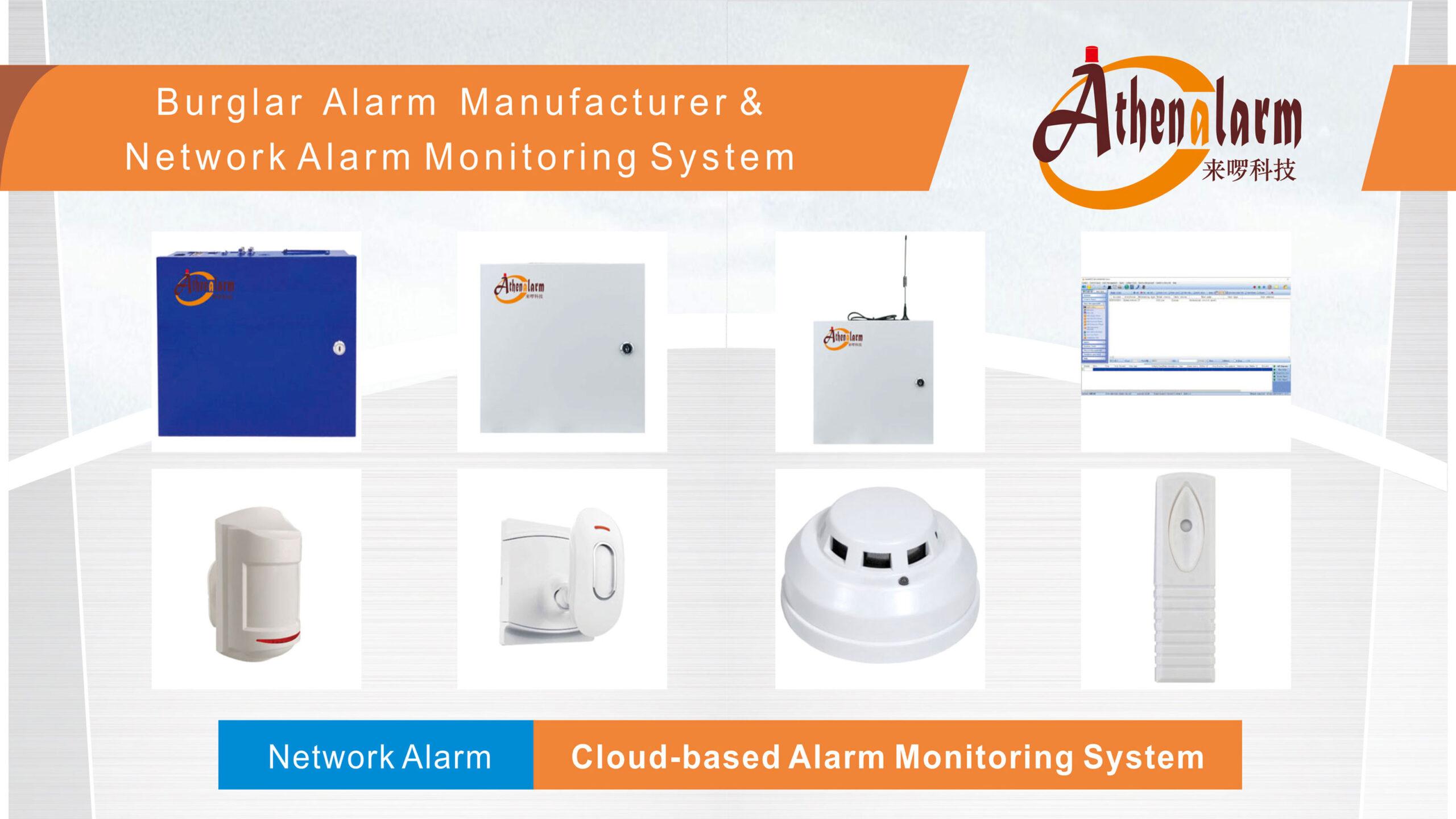
Hardware integration across the entire signal chain. In an integrated ecosystem, the control panels, motion sensors, detectors, modules, and peripherals are all engineered and tested to work together. This eliminates the compatibility guesswork that plagues multi-vendor sourcing. Intrusion alarm control panels, PIR motion sensors (standard, curtain, and wide-angle variants), photoelectric smoke detectors, gas detectors, digital vibration detectors, door contacts, panic buttons, and audible alarms all operate as a coherent system rather than a collection of independent components. For downstream installers, this translates to faster commissioning, fewer callbacks, and higher customer satisfaction.
👉 Athenalarm network alarm system
Wireless and multi-communication architecture. Modern commercial alarm deployments rarely have the luxury of a single clean communication path. A true integrated ecosystem supports GSM/4G, Wi-Fi, TCP/IP, PSTN, and hybrid communication modes so that distributors can configure systems appropriate for diverse installation environments — from rural residential properties with limited broadband infrastructure to urban commercial sites requiring redundant communication paths. Wireless burglar alarm kits built on this architecture are particularly valuable for wholesale distributors serving installers who work on existing buildings where cable runs are impractical or cost-prohibitive.
👉 Athenalarm GSM/4G WIFI alarm system
Network alarm monitoring integration. This is where the ecosystem concept moves farthest beyond what traditional alarm parts distributors typically offer. Beyond hardware, a sophisticated integrated platform connects the installed alarm system to centralized management software capable of handling multiple sites across a geographic region. Alarm events trigger real-time notifications. Where the system is combined with CCTV capabilities, video verification can confirm whether a triggered zone represents a genuine intrusion or a false alarm before a dispatch decision is made.

For commercial customers managing banks, retail chains, industrial facilities, or residential communities with dozens of units, this level of centralized visibility is not a luxury — it is a baseline expectation. Distributors who can supply this layer of the system alongside the hardware are selling to a completely different buyer conversation than distributors who are only quoting sensor prices.
OEM and private-label capability. Perhaps the single most strategically significant feature of a fully integrated ecosystem for distributors is the ability to put their own brand on the product. This is where smart alarm system components sourced from a capable security alarm OEM manufacturer become a distributor’s proprietary product line. Custom logos, packaging, manuals, hardware modifications, and software adjustments transform a manufacturer’s platform into the distributor’s branded offering. The customer loyalty implications are substantial — buyers who associate a system’s performance with your brand are buying from you again, not searching for the cheapest source of the next component.
The scalable alarm system supply chain this model enables also addresses one of the most persistent frustrations in traditional alarm distribution: the difficulty of growing order volumes without proportionally growing operational complexity. With ecosystem-integrated sourcing, expanding from supplying fifty residential systems per quarter to five hundred does not require eight new supplier relationships. It requires one.
Athenalarm: The Strategic Partner Built for This Transition
Not every manufacturer who claims to offer OEM capabilities or integrated solutions has the depth of experience and product breadth to actually deliver on those claims at the scale alarm parts distributors need. This is where Athenalarm’s specific background matters.
Founded in 2006 and operating from Shenzhen — China’s established hub for electronics manufacturing — Athenalarm has spent nearly twenty years focused exclusively on burglar alarm design, manufacturing, and export. That specialization is significant. Unlike manufacturers who produce security products as one category among many, Athenalarm’s entire R&D investment, quality management infrastructure, and engineering expertise is concentrated in burglar alarm systems. ISO 9001 certification, FCC certification and CCC certification reflect the quality management framework that underpins production, and a stated policy of 100% functional testing before shipment means that products leaving the factory have been individually verified, not statistically sampled.
For alarm parts distributors evaluating whether a manufacturer can serve as a long-term partner rather than just another parts vendor, track record across diverse deployment environments matters considerably. Athenalarm’s systems have been deployed in banking institutions, residential communities, commercial facilities, hotels, retail stores, and critical industrial infrastructure. Each of these sectors has distinct technical requirements, and serving them reliably over nearly two decades demonstrates engineering depth that goes beyond catalog specifications.
The Product Ecosystem in Detail
The practical foundation of Athenalarm’s offering for distributors is a hardware lineup that spans every element of a complete burglar alarm installation. The intrusion alarm panel series serves as the system core, with address modules and linkage modules enabling large-scale zone configurations for commercial projects. The PIR motion sensor range covers standard detection, curtain-mode detection for corridor and perimeter applications, and wide-angle configurations for open spaces. The detector portfolio extends to photoelectric smoke detection, gas detection, and digital vibration detection — capabilities that allow a distributor to serve customers with complex multi-hazard detection requirements without sourcing from additional vendors.
The alarm component category covers audible alarms and warning lights — the output devices that complete the signal chain. Voice reminder modules add an additional layer of interaction capability for applications where audio messaging enhances the system’s function. And the smart home range, centered on the GSM/4G Wi-Fi alarm system, addresses the residential and small-commercial market that continues to represent strong growth for alarm wholesale distributors globally.
Critically, Athenalarm’s network alarm monitoring system represents the platform layer that transforms component-level sourcing into solution-level selling. This system integrates intrusion alarm hardware with CCTV capabilities to enable video-verified alarm response — when a detector triggers, the monitoring platform can immediately pull live footage from the associated camera, allowing operators to visually confirm an intrusion before deciding on response actions. False alarm rates — which remain a persistent problem for commercial alarm customers and a source of significant operational cost — are substantially reduced through this verification capability. The platform supports LAN, WAN, and 4G connectivity modes, making it deployable across virtually any commercial network infrastructure. Centralized management software allows alarm centers to monitor multiple sites through a single interface, with event storage, interactive mapping, and remote arm/disarm capabilities.
OEM and Private-Label Services: The Distributor’s Margin Engine
For alarm parts distributors specifically, Athenalarm’s OEM service offering deserves particular attention. The scope of customization available covers the full range of what a distributor would need to build a proprietary branded product line. Hardware modifications, software adjustments, custom firmware configurations, private packaging, branded manuals, and logo application across both wired and wireless platforms (including PSTN, GSM, 4G, TCP/IP, and Wi-Fi variants) can all be accommodated.

This means a distributor working with Athenalarm can go to market under their own brand with products engineered by a manufacturer with nearly twenty years of specialized experience — without the capital investment required to develop those products independently. The competitive positioning this enables is genuinely different from anything achievable through standard component reselling. When your customer buys your branded wireless alarm system, they are buying a relationship with your company, not just a box with someone else’s name on it.
Practical commercial terms reinforce the partnership model: sample support for evaluation before commitment, a seven-day return policy for quality issues, one-year warranty coverage, flexible MOQ structures designed to accommodate distributors at different volume levels, and global technical support. These are not afterthought policies — they are the infrastructure of a genuine B2B partnership.
A Practical Upgrade Path: How Alarm Parts Distributors Can Make the Transition
Understanding the strategic logic of moving toward an integrated ecosystem model is one thing. Knowing how to actually execute the transition without disrupting existing operations is another. The process does not require flipping a switch. It is better understood as a staged evolution, and Athenalarm’s OEM service framework maps cleanly onto that kind of phased approach.
Stage 1: Portfolio Assessment and Opportunity Mapping
The first step is an honest inventory of your current parts portfolio and a mapping of where your customers’ demand is actually concentrated. Which product categories generate your highest revenue? Which generate your best margins? Where are customers asking you for complete systems or bundled solutions that you currently cannot supply? This assessment typically reveals three or four clear opportunities where ecosystem sourcing would immediately improve both competitive positioning and margin.
For many alarm parts distributors, the quickest wins are in wireless alarm system kits for residential and small commercial installations — a category where customer demand for plug-and-play solutions is strongest and where the margin differential between component-level and system-level selling is most pronounced.
Stage 2: Product Design and Private-Label Configuration
Once target product categories are identified, the design and prototyping phase begins. Working directly with Athenalarm’s team, a distributor can define the exact system configuration — communication modes, zone capacity, detector mix, software features — appropriate for their primary customer segments. This is also where private-label decisions are made: brand name, logo placement, packaging design, and manual language. The distributor’s brand goes on the product; Athenalarm’s engineering goes into it.
Stage 3: Manufacturing, Quality Assurance, and Compliance
Production under ISO 9001 quality management, with individual unit functional testing, ensures that products leaving the factory meet the performance specifications agreed during the design phase. For distributors selling into markets with specific certification requirements, Athenalarm’s existing compliance framework provides a foundation — though specific market regulatory requirements should always be discussed during the consultation phase.
Stage 4: Delivery, Branding Launch, and Ongoing Support
Once product arrives, the distributor’s branded alarm system is ready for market. Technical training resources — including documentation, download support, and Athenalarm’s technical support channel — mean that distributor sales teams and downstream installers are not left to figure out the product independently. Ongoing support for software updates, technical queries, and after-sales issues remains available through the partnership.
Measuring the Upgrade
Success indicators for distributors who have made this transition include: a measurable increase in average order value (systems priced as integrated solutions rather than individual components), stronger customer retention as buyers build their installation practices around your branded products, a reduced number of active supplier relationships with no reduction in product range, and improved gross margin per transaction. The last metric is the most immediate and the most significant — the difference between selling a PIR sensor and selling a branded wireless alarm kit is not incremental. It is categorical.

Addressing the “We Already Have Suppliers” Objection
This is the most common hesitation among distributors who have established vendor relationships. The key distinction is not whether existing suppliers are adequate for component sourcing — they may well be. The question is whether those existing relationships enable you to compete in the system-level market that your customers are increasingly moving toward. Compatibility-tested ecosystems, private-label capabilities, network monitoring integration, and structured partnership support are not features available across every component supplier relationship. They require a manufacturer whose business model is built around enabling distributors to succeed at the solution level, not just at the parts level.
Conclusion: The Business Model Upgrade Is the Competitive Advantage
The alarm parts distribution market in 2026 rewards businesses that can demonstrate value above and beyond price competitiveness on individual components. Installers, integrators, commercial project managers, and facilities procurement teams are not looking for cheaper sensors — they are looking for trusted supply partners who can deliver complete, reliable, tested security solutions that reduce their project complexity and risk.
Alarm parts distributors who make the transition from isolated component reselling to branded system solutions — powered by a manufacturer-integrated burglar alarm ecosystem — gain access to a fundamentally different competitive conversation. The sourcing complexity that once required managing dozens of vendor relationships collapses into a single, reliable manufacturing partnership. The margin profile that once depended on volume at thin percentages transforms into system-level sales with significantly stronger returns. The customer relationship that once reset with every order evolves into a brand loyalty dynamic built around your proprietary product line.
Athenalarm has spent nearly twenty years building the technical depth, product breadth, OEM capability, and quality infrastructure that makes this kind of partnership viable for distributors operating at any scale. The integrated ecosystem — spanning hardware components, wireless alarm kits, network monitoring platforms, and full private-label customization — is not a product catalog. It is a business model enabler.
If you are an alarm parts distributor evaluating how to grow revenue, improve margins, and build a more defensible market position in the years ahead, the logical next step is a direct conversation with a manufacturer who has already solved the integration problem.
Visit https://athenalarm.com/burglar-alarm-manufacturer/ to explore Athenalarm’s full OEM security alarm systems portfolio, request product samples, or schedule a partnership consultation. You can also reach the team directly via WhatsApp for a faster response. The distributors who begin this conversation today are the ones who will be selling branded, margin-positive security solutions while their competitors are still negotiating sensor prices.
The future of alarm distribution belongs to solution partners, not parts suppliers. The infrastructure to make that transition is already built — it is simply a matter of whether you choose to use it.
Athenalarm — Specialized Burglar Alarm Manufacturer Since 2006 | Shenzhen, China | ISO 9001 & FCC & CCC Certified | OEM / ODM / Private Label | Global Export