Unified Telemetry Resilience Architecture (UTRA): A B2B Engineering Framework for Commercial Intrusion Panels, Multi-Path Signaling, and CMS Interoperability
In modern commercial security engineering, system reliability is no longer defined by whether an intrusion panel can “function under normal conditions.” The real question is far more uncomfortable: what happens when everything starts failing at once—silently, partially, and unpredictably?
Across large-scale deployments such as logistics hubs, financial institutions, and distributed retail infrastructure, alarm systems rarely fail in obvious ways. Instead, they degrade gradually. A panel may still appear online. Heartbeats may still be transmitted. IP sessions may still be established. Yet somewhere between the edge device and the Central Monitoring Station (CMS / ARC), the integrity of the telemetry chain quietly collapses.
This gap—between apparent connectivity and actual deliverability—is where most commercial intrusion architectures fail. The Unified Telemetry Resilience Architecture (UTRA) was introduced to address precisely this problem. It does not redefine alarm hardware. It redefines how alarm telemetry must behave as a system under stress.
Rather than treating sensors, control panels, communication modules, and monitoring receivers as independent components, UTRA forces them into a single engineering assumption: a security system is only as reliable as its weakest invisible transition between states.
The Hidden Engineering Problem: Why “Compliant” Systems Still Fail
Most commercial intrusion systems operate within accepted regulatory frameworks such as EN 50131 or UL 1610. On paper, these systems are compliant. In practice, compliance does not guarantee end-to-end reliability under degraded network conditions.
Three failure modes dominate real-world deployments.
The first is path degradation without full failure. IP networks introduce latency, jitter, NAT translation delays, and intermittent packet loss. Cellular fallback links introduce additional uncertainty through carrier-level traffic shaping or APN filtering. None of these conditions necessarily trigger a “system fault,” yet they directly impact alarm delivery timing and CMS reception consistency.
The second is semantic loss during protocol translation. Legacy formats such as Contact ID compress event information into rigid numeric structures. When translated into IP-based systems, this structure is often reconstructed at the receiver side, not preserved at the origin. The result is a subtle but critical loss of context: complex intrusion events are reduced to simplified codes that may not reflect real incident severity.
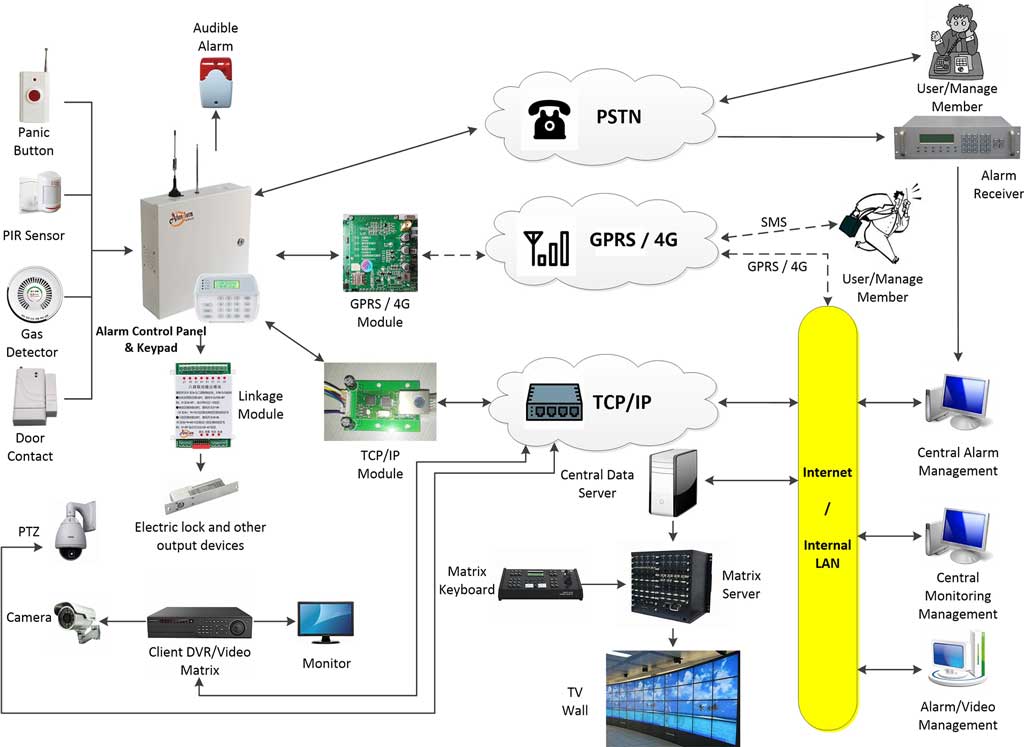
The third is architectural fragmentation. In many deployments, edge devices, communication modules, and CMS receivers are sourced from different vendors. Each layer is individually compliant, yet no layer guarantees consistent end-to-end verification. This creates a dangerous illusion: every subsystem is “working,” while the full system is not provably coherent.
UTRA is designed to eliminate this category of failure by treating telemetry as a continuous, verifiable lifecycle rather than a sequence of disconnected components.
UTRA in Context: Aligning with EN 50131 and UL 1610 Without Breaking Compatibility
UTRA does not replace existing security standards. Instead, it reorganizes them into a system-level execution model.
Within EN 50131, system grades define resistance levels, supervision requirements, and communication robustness. However, these requirements are often interpreted at the device level rather than the system level. For example, dual-path communication is required in higher grades, but simultaneous path supervision is not strictly enforced as a continuous validation mechanism.
UTRA formalizes this distinction. It defines dual-path operation not as a backup mechanism, but as a concurrent verification system. Under this model, both primary and secondary paths must continuously report health status, latency, and acknowledgment behavior—not only when failure occurs.
Similarly, UL 1610 emphasizes central station reliability, but does not enforce strict constraints on upstream semantic consistency. UTRA extends this by introducing payload integrity requirements: event data must remain structurally identical from edge generation to CMS ingestion, regardless of transport layer changes.
This creates an important engineering shift: compliance becomes a baseline, not a guarantee.
The UTRA Model: From Layered Architecture to Continuous Telemetry Integrity
UTRA compresses the entire alarm transmission chain into four operational dimensions. These are not theoretical abstractions—they represent measurable system behaviors.
The first dimension, Path Integrity, replaces traditional “primary + backup” logic with concurrent supervision. Instead of waiting for a failure event, systems continuously evaluate both paths in real time. Metrics such as round-trip time (RTT), packet loss rate, and acknowledgment delay become persistent variables rather than diagnostic outputs.
The second dimension, Payload Validity, ensures that alarm data retains semantic consistency across all transitions. Event definitions, zone identifiers, timestamps, and partition metadata must be bound at the moment of generation. This eliminates reliance on CMS-side reconstruction logic, which is often a hidden source of misinterpretation.
The third dimension, Architectural Closure, introduces bidirectional verification between panel and CMS. A transmission is not considered valid until acknowledgment is received and logged as a system-level state. This transforms alarm delivery from a one-way event into a closed-loop verification process.
The fourth dimension, Measured Quality Assurance, replaces qualitative reliability claims with quantitative engineering thresholds. In a UTRA-aligned system, performance is continuously tracked using real-world telemetry metrics such as:
- End-to-end latency target: < 300 ms
- Heartbeat recovery time: < 3 seconds
- Dual-path consistency deviation: < 0.01%
- CMS acknowledgment success rate: ≥ 99.99%
These parameters shift intrusion systems from feature-based products into measurable communication infrastructures.
The Core Engineering Anxiety: Systems Do Not Fail at the Moment of Alarm—They Fail Before It
In enterprise deployments, the most dangerous failure is not total system shutdown. It is partial degradation that remains invisible until an incident occurs.
A system may continue reporting normal status while NAT sessions expire silently, cellular failover becomes unstable, or CMS queues begin dropping low-priority packets under load. From an operator perspective, nothing appears wrong. From an engineering perspective, the system is already compromised.
UTRA addresses this by enforcing continuous bidirectional verification. If acknowledgment latency exceeds thresholds or heartbeat behavior deviates from expected patterns, the system is required to downgrade its path state immediately—not after disconnection, but during early degradation.
This introduces a critical concept: connectivity is not binary; it is a continuous reliability spectrum.
Reference Implementation: Athenalarm AS-9000 as a UTRA-Aligned Architecture
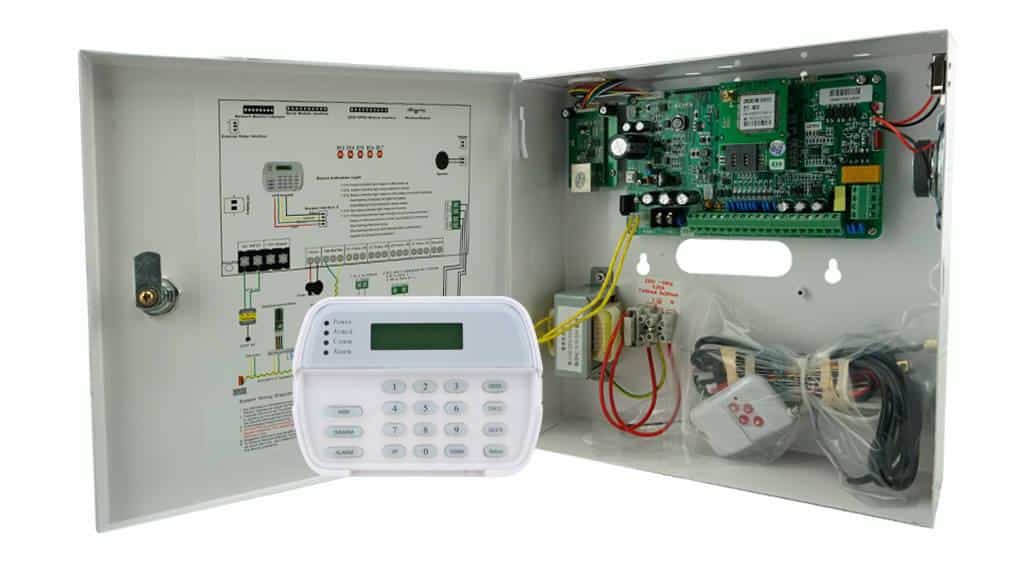
In practical deployments, systems such as the Athenalarm AS-9000 can be interpreted as a hardware-level implementation of UTRA principles.
Rather than treating IP and cellular modules as primary and backup respectively, the architecture runs them as simultaneously active supervision layers. This ensures that failover is not an event-driven reaction, but a state-managed transition.
At the field level, RS-485 linear bus architecture ensures deterministic communication behavior, minimizing reflection noise and maintaining predictable voltage characteristics across distributed expansion modules.
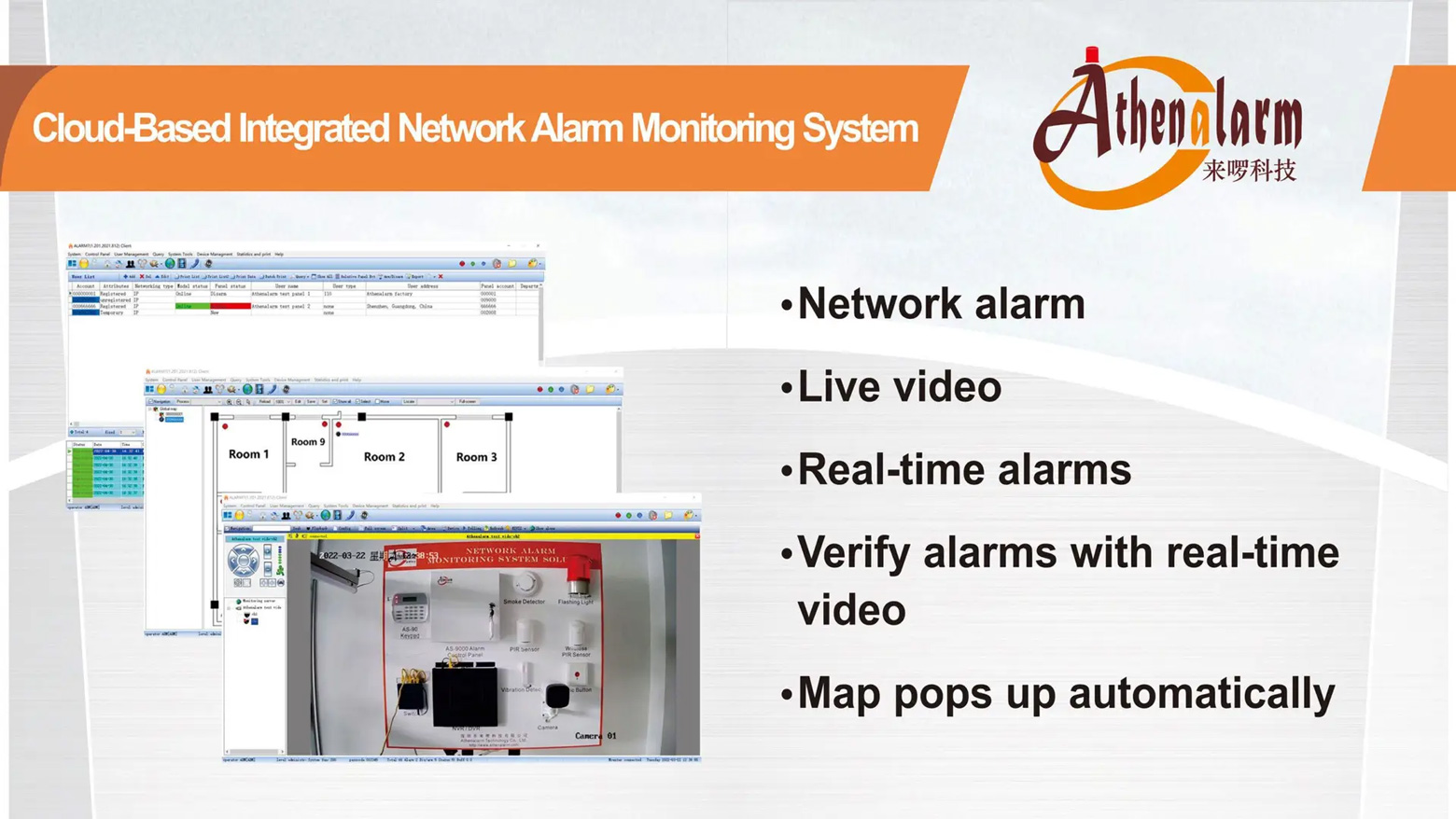
At the CMS level, the system does not simply deliver alarm messages. It delivers structured telemetry streams, including latency indicators, path switching events, and acknowledgment metadata—allowing operators to evaluate not just what happened, but how reliably the system behaved while it happened.
Why UTRA Matters: From Device Selection to System Verification
The most significant contribution of UTRA is not technical novelty, but a shift in evaluation logic.
Traditional procurement questions focus on features:
“Does it support IP?”
“Does it support 4G backup?”
“Is it encrypted?”
UTRA reframes these questions into system behavior under stress:
“What happens when latency increases beyond 400 ms?”
“Does the system maintain ACK integrity under packet jitter conditions?”
“Can semantic event structure survive dual-path degradation?”
“What is the measurable probability of silent failure during partial network outage?”
This shift is critical because it transforms intrusion systems from hardware purchases into verifiable engineering systems.
Conclusion: From Product Evaluation to Engineering Validation
For enterprise security integrators, distributors, and infrastructure operators, UTRA represents a new evaluation paradigm rather than a product category.
The next step is no longer selecting a “better alarm panel.” It is establishing a repeatable validation methodology that can be applied across vendors and deployments:
- Testing dual-path supervision under controlled network degradation
- Measuring CMS acknowledgment stability under jitter and latency conditions
- Evaluating semantic consistency across protocol translation layers
- Identifying silent failure windows under long-duration operational load
Only when these variables can be measured, reproduced, and verified can a commercial intrusion system be considered truly reliable in engineering terms.
UTRA does not redefine security hardware. It redefines what it means for a security system to be trusted.